Table of Content

Introduction
Dr. Apoorv Loya at Asteria Aesthetics in Bhopal hears this question often. A patient finds a soft lump under the skin, searches online, and wants to know if surgery is the only path forward.
A lipoma is a soft, noncancerous lump of fat that forms just under the skin, sealed inside a thin capsule. That capsule is the reason the honest answer isn't a simple yes or no.
Two real non surgical options exist. Dr. Apoorv Loya performs both at Asteria Aesthetics in Bhopal, corticosteroid injections and liposuction assisted removal. You will learn what each one can really do, why lipoma creams never reach the lump at all, what causes a lipoma to form in the first place, and when surgery is still the better answer.
Is It Possible to Remove a Lipoma Without Surgery?
A lipoma cannot usually be completely removed without surgery. Corticosteroid injections may shrink smaller lipomas, while liposuction assisted removal can reduce or remove the fatty contents with a smaller incision. Creams, oils, and home remedies have no proven benefit. Surgical excision remains the most complete treatment because it removes the lipoma and its capsule.
What Is a Lipoma, and Why Doesn't Cream Reach It?
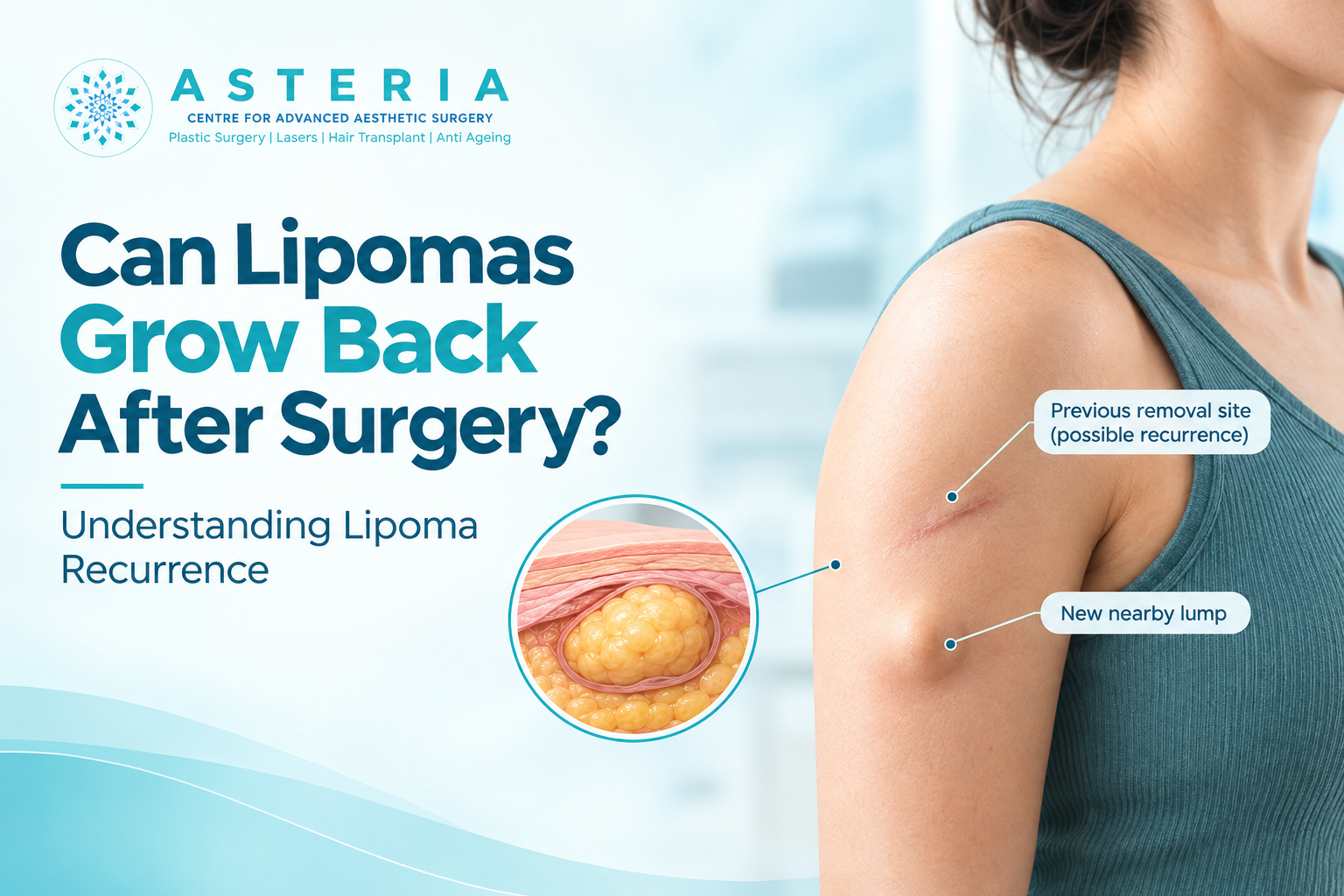
A lipoma is a slow growing lump of fat cells. It forms just under the skin, wrapped in its own thin capsule. That capsule is the reason creams do not work on it.
Creams and ointments only reach the top layers of skin. A lipoma sits below that, sealed inside its own capsule. No cream, oil, or ointment can soak in that deep or break down fat locked inside connective tissue.
According to NCBI StatPearls, lipomas are the most common type of benign lump found under the skin, occurring in about 2 new cases per 1,000 people each year. That is a lot of people, and none of them can shrink a lipoma with something rubbed on top of the skin.
Why Do Lipomas Form?
Genetics plays the largest role in why a lipoma forms, with metabolic and hormonal factors adding to the risk in some patients. According to NCBI StatPearls, 2 to 3 percent of lipoma patients have multiple lesions that run in the family, often linked to a gene change on chromosome 12 called the HMGA2 fusion. Lipomas also occur more often in people with obesity, high cholesterol, or diabetes.
Most lipomas are not caused by diet or lifestyle choices, so patients rarely did anything wrong. A first degree relative with a lipoma raises your own odds of developing one. In rarer cases, several lipomas appearing together across different family members points to a hereditary condition called familial multiple lipomatosis, which is worth mentioning to your doctor so it can be evaluated properly.
Physical trauma to an area of fatty tissue is sometimes linked to a lipoma forming at that same site later, though this connection is less common than genetic and metabolic factors.

Does Any Oil or Cream Work on a Lipoma?
No. This holds true no matter what ingredient a product claims to contain. The capsule around a lipoma blocks any topical product from reaching the fat cells inside it.
Products marketed as lipoma dissolving creams have no real clinical evidence behind them. Using one carries its own risk of skin irritation or an allergic reaction. Meanwhile the lipoma underneath stays exactly the same size.
Do Home Remedies Shrink a Lipoma?
| Remedy | Claimed Benefit | Medical Evidence |
| Apple cider vinegar | Shrinks fat deposits | No clinical evidence for lipomas |
| Turmeric | Reduces inflammation and lump size | Fights inflammation in general, but no evidence it shrinks lipomas |
| Castor oil | Softens and breaks down fatty tissue | No clinical studies support this for lipomas |
| Essential oils | Dissolves fat cells | No evidence for lipoma use |
| Diet changes | Prevents lipomas from forming | Good for general health, no direct evidence for lipoma prevention |
None of these have been shown to shrink an existing lipoma. According to a 2025 study at a government medical college in India, lipoma was the single most common type of benign soft tissue lump, making up 47.9 percent of all cases recorded.
Do Not Try to Remove a Lipoma Yourself
Never puncture, squeeze, or cut a lipoma at home. This is a real risk many patients underestimate once they see how soft and shallow a lipoma feels.
Attempting to remove a lipoma yourself can cause a bacterial infection, permanent scarring, damage to nearby nerves or blood vessels, and an incomplete removal that leaves the lump likely to grow back. It also removes the chance for a doctor to confirm the lump is actually a lipoma and not something that needs a different kind of care.
If you are tempted to deal with a lipoma at home, book a short consultation instead. A proper diagnosis and a safe removal option cost far less than treating a complication.
What Non Surgical Options Actually Work?
Two real non surgical options exist. Dr. Apoorv Loya performs both at Asteria Aesthetics in Bhopal, corticosteroid injections and liposuction assisted removal. Both can shrink a lipoma. Neither one guarantees it disappears completely.
Do Corticosteroid Injections Shrink a Lipoma?
Yes, corticosteroid injections can meaningfully shrink a lipoma, and results vary by size and location. According to a 2018 clinical study that followed eight patients with painful lipomas under the skin, one injection of a steroid called triamcinolone shrank the lipomas by an average of 60 percent over four months, with no serious side effects. Two of the eight patients had mild, temporary lightening of the skin where they were injected.
This is the non surgical option most patients ask about first. It works best on smaller lipomas. Patients should weigh this option against the chance the lump does not fully go away.
How Does Liposuction Assisted Removal Work?
Liposuction assisted removal uses a thin tube inserted through a tiny cut to suction the fatty contents out of the lipoma. It leaves a smaller scar than cutting the lipoma out.
The tradeoff is completeness, since any capsule tissue left behind can eventually regrow. See how recurrence rates compare by removal method. The capsule can be left partly behind, so results vary by technique. In one long term study, patients were treated with liposuction plus a small amount of extra tissue removal. Among those who responded to a follow up survey one to ten years later, 92 percent were happy with how it looked, and none reported the lipoma coming back.
The researchers noted that liposuction on its own, without removing any leftover capsule tissue, carries a higher chance of tissue being left behind. This is why Dr. Apoorv Loya reserves this option for larger or softer lipomas where a smaller scar matters most, and often removes any remaining tissue at the same time.
Why Not Just Wait and Watch?
Watching and waiting is a reasonable choice for a small, painless lipoma that is not changing. It is not a treatment though, and it will not shrink the lump on its own.
Monitoring makes sense when a lipoma is not growing, is not painful, and is not in a spot that bothers you. Bring it back to a doctor rather than continuing to wait if you notice any of the following.
- The lump grows quickly over a matter of weeks or months
- New pain or tenderness develops where there was none before
- The color or texture of the skin over the lump changes
- Several new lumps appear around the same time
- The lump starts interfering with movement, clothing, or daily activities
Any one of these is a reason to have it checked rather than a reason to panic. Most of the time it still turns out to be a straightforward lipoma, but a doctor needs to confirm that.
Non Surgical Options Compared
| Option | What It Does | Completeness | Best Suited For |
| Corticosteroid injection | Shrinks fat cells with a targeted injection | Partial, rarely full removal | Small, soft lipomas |
| Liposuction assisted removal | Suctions fatty contents out through a small cut | Partial to near complete, depending on technique | Larger, softer lipomas where scar size matters most |
| Surgical excision | Removes the lipoma with its full capsule | Complete | Anyone who wants the lump gone for good |
| Lipoma removal cream | Applied on top of the skin | None, does not reach the lipoma | Not a genuine option |
What About Injection Lipolysis, Laser, or Radiofrequency?
These three treatments exist, and some clinics offer them. The evidence behind using them on lipomas specifically is still limited compared with injections or liposuction. Dr. Apoorv Loya does not currently offer these at Asteria Aesthetics, and it helps to know why.
Injection lipolysis dissolves fat cells with a chemical injection. It is more established for general cosmetic fat reduction than for lipomas. Laser treatment melts fat with heat, but it tends to underperform on larger or deeper lipomas. Radiofrequency therapy is not yet a standard lipoma treatment with strong evidence behind it. All three are worth knowing about, but none of them currently match the track record of injections or liposuction.

When Does Surgical Excision Make More Sense?
Surgery becomes the better call when a lipoma is large, growing, pressing on a nerve, or when someone just wants it gone for good instead of reduced. Removing the lipoma with its full capsule is what keeps it from coming back. That is the same idea behind every limit of the non surgical options above. Whatever capsule tissue gets left behind is what can eventually grow back.
Surgery is also the only one of these options where the removed tissue gets sent for lab testing. Complete capsule removal is also what keeps a lipoma from coming back. See our full breakdown of lipoma recurrence rates by removal method for the numbers. That confirms the lump is benign, not something that needs a different kind of care.
Lowering Your Risk of New Lipomas
There is no guaranteed way to prevent a lipoma, especially when genetics is the main driver. A few habits may still lower your overall risk, particularly for the metabolic factors linked to lipomas.
Maintaining a healthy weight and managing conditions like high cholesterol or diabetes address two of the risk factors StatPearls links to lipoma formation. Avoiding repetitive trauma to the same patch of skin may help too, since some lipomas are reported at old injury sites. None of this shrinks a lipoma you already have. It is about the next one, not the one you are dealing with now.
Key Facts
- A lipoma is a benign, fat filled lump sealed inside a capsule under the skin
- Cream cannot remove a lipoma because it cannot reach through that capsule
- Genetics accounts for 2 to 3 percent of lipoma patients having a familial pattern, per NCBI StatPearls
- One corticosteroid injection shrank lipomas by 60 percent on average in a 2018 study
- Liposuction assisted removal leaves a smaller scar, but capsule tissue can be left behind
- Lipoma made up 47.9 percent of benign soft tissue lumps in a 2025 Indian hospital study
- Surgery that removes the full capsule is the only method that removes a lipoma completely
Making the Right Choice for Your Lipoma
Deciding between watching, an injection, a smaller procedure, or full removal comes down to your lipoma itself, its size, where it sits, and what it is actually costing you day to day.
None of that gets clearer from another search. A short consultation with Dr. Apoorv Loya at Asteria Aesthetics in Bhopal confirms what you are dealing with and lays out which option actually fits your case, with no pressure toward surgery unless it is genuinely the right call.
📞 +91 98935 02911
📧 drapoorvloya@gmail.com
📍 10, Ramanand Nagar, Near Lalghati Square, Bhopal, M.P. 462023
Frequently Asked Questions
Can a lipoma disappear on its own without any treatment?
Rarely. Lipomas tend to stay the same size or grow very slowly over years instead of shrinking on their own. Some form of medical treatment is usually needed to reduce or remove one.
What medicine removes a lipoma completely?
No pill or oral medicine removes a lipoma. Corticosteroid injections can shrink one, but they rarely eliminate it fully. Complete removal needs surgery that takes out the lump along with its capsule.
Do home remedies like apple cider vinegar or turmeric shrink a lipoma?
No. Neither one has clinical evidence supporting lipoma reduction. Turmeric fights inflammation in general, but that does not translate into shrinking fat sealed inside a capsule.
How effective are steroid injections at shrinking a lipoma?
A 2018 clinical study found a single corticosteroid injection shrank lipoma size by roughly 60 percent over four months. Results vary by lipoma size, and full disappearance is uncommon.
Is injection lipolysis a proven lipoma treatment?
Not firmly. It is more established for general cosmetic fat reduction than for lipomas specifically, and evidence for lipoma use is still limited. It is not currently offered at Asteria Aesthetics.
Does laser treatment work for lipoma removal?
Laser treatment can shrink smaller lipomas in some cases, but results are inconsistent for larger or deeper ones. It is not a technique Dr. Apoorv Loya currently offers at Asteria Aesthetics.
Can a lipoma run in the family?
Yes, in a small share of patients. NCBI StatPearls notes that 2 to 3 percent of lipoma patients have lesions that run in a familial pattern, sometimes linked to a hereditary condition called familial multiple lipomatosis.
Is it safe to squeeze or cut open a lipoma myself?
No. Doing this at home risks infection, permanent scarring, nerve or blood vessel damage, and an incomplete removal that grows back. It also skips the diagnosis step that confirms the lump is actually a lipoma.
Is lipoma treatment covered by insurance in India?
Usually not, since lipoma removal is generally treated as an elective procedure unless the lump is causing pain, pressing on a nerve, or growing rapidly. Ask your insurer directly, and confirm with the clinic whether your specific case might qualify as medically necessary.



 Get personalized facial analysis and treatment planning